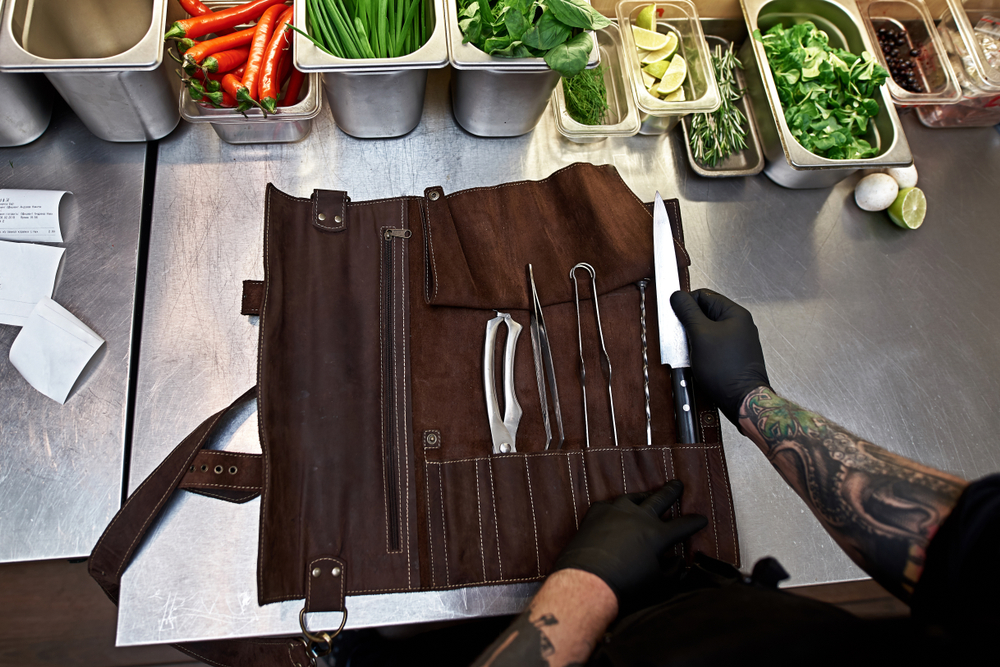
For many professional chefs, a personal set of kitchen knives is part of their everyday working equipment. If you use your own knives, you may need to transport them to and from work, between venues or to an outside catering job.
However, chef knives are still bladed articles, so there are laws governing when they can be carried in public.
The important point for chefs is that using a knife for work can provide a legitimate reason for having it with you. It is not, however, a blanket exemption allowing a chef to carry knives anywhere simply because they work in a kitchen.
This guide looks at what the law says, what it means for chefs travelling with their equipment and how dedicated knife storage can help you transport your tools safely and practically.
Please note: This guide provides general information and is not legal advice. Knife law differs between jurisdictions within the UK and may change. For advice about a particular situation, check current government guidance, contact the relevant police service or seek legal advice.
In England and Wales, Section 139 of the Criminal Justice Act 1988 makes it an offence to have an article with a blade or sharp point in a public place without good reason or lawful authority.
The legislation specifically provides a defence where a person can prove that they had the article for use at work.
GOV.UK also lists using a knife for your work as an example of a “good reason” for carrying a non-banned knife in public.
For a professional chef, this means that carrying kitchen knives genuinely required for work can have a recognised legal justification.
However, this does not create an automatic exemption for chefs. Current Crown Prosecution Service guidance for England and Wales states that having a bladed article for work or employment does not automatically provide a reasonable excuse. The possession must be reasonable and there should be an immediate connection between possessing the article and the work.
If someone is charged with carrying a knife illegally, the circumstances of the individual case matter. GOV.UK states that a court will ultimately decide whether the person had a good reason.
For chefs, the clearest situation is transporting professional kitchen knives because they are required for their work.
Examples could include taking your knife kit:
The key legal point is the connection between having the knife and the work for which it is required.
CPS guidance illustrates the importance of this connection by referring to a court case involving tools found in a vehicle when the person was not working. The fact that the items could be connected with their occupation did not automatically establish the necessary excuse in those circumstances.
For chefs, the safest general principle is therefore straightforward: carry your professional knives when you genuinely need them for work rather than treating your occupation as a general reason to have them with you at other times.
The broad principle is similar across the UK, but the legislation is not identical in every jurisdiction.
Section 139 of the Criminal Justice Act 1988 applies to having an article with a blade or sharp point in a public place.
It provides a defence where the person can prove that they had good reason or lawful authority, with having the article for use at work specifically included.
Scotland has separate legislation.
Section 49 of the Criminal Law (Consolidation) (Scotland) Act 1995 covers having an article with a blade or point in a public place.
As in England and Wales, the legislation provides for a defence based on good reason or lawful authority and specifically includes having the article for use at work.
Knife offences are also enforced in Northern Ireland. Police Service of Northern Ireland records identify offences involving possession of an article with a blade or point in a public place under Section 139 of the Criminal Justice Act 1988.
Because criminal law and procedure can differ between jurisdictions, anyone needing advice about a specific situation should use guidance relevant to the part of the UK in which they are travelling or working.
For the purposes of the law in England and Wales, a public place can cover considerably more than a street or park.
CPS guidance explains that a public place includes highways and other premises or places to which members of the public are permitted access, whether payment is required or not.
This means putting a chef knife inside a bag does not take it outside the scope of the law.
CPS guidance also explains that “having with” someone can extend beyond physically holding or carrying an item. It can include circumstances where an article is nearby, under the person's control or immediately accessible, such as in a nearby bag or under a car seat.
For chefs, the relevant issue is therefore why the knives are with you in that particular situation.
You may have heard that knives with blades of three inches or less can legally be carried without a specific reason.
This rule is narrower than it sometimes sounds.
In England and Wales, the normal exception relates to a folding pocketknife where:
A conventional chef knife has a fixed blade, so the folding-pocket knife exception does not generally apply to the professional kitchen knives used by chefs.
Your chef knife therefore does not become exempt from the normal carrying rules simply because it happens to have a relatively short blade.
The legislation does not state that a chef must use a particular knife wallet, roll, bag or case for a work-related defence to apply.
However, securely containing sharp kitchen knives is sensible when transporting professional equipment.
Rather than carrying loose knives inside a general bag, a dedicated knife wallet or roll bag can keep individual tools organised and separated during transport.
The benefits are practical:
These are practical storage benefits. Using a knife roll or case does not itself make carrying a knife legal. You still need a legitimate reason for having the knives with you.
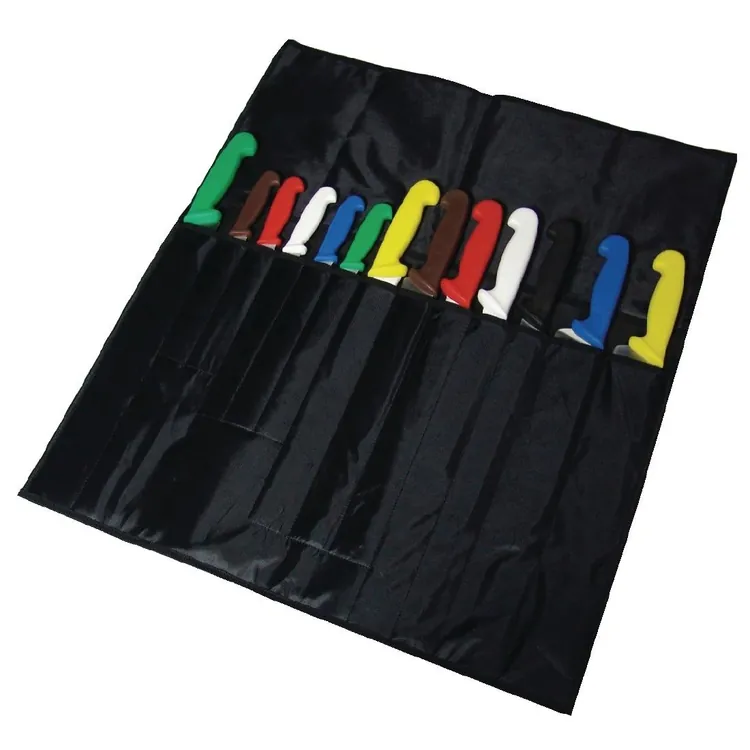
A knife roll is a practical choice for chefs who regularly transport several kitchen knives.
Individual compartments allow chef's knives, paring knives, boning knives and other tools to be kept separately, while the roll or wallet keeps the collection together for transport.
Diamond stocks a selection of knife wallets, roll bags and chef knife bags for different sizes of professional knife kit.
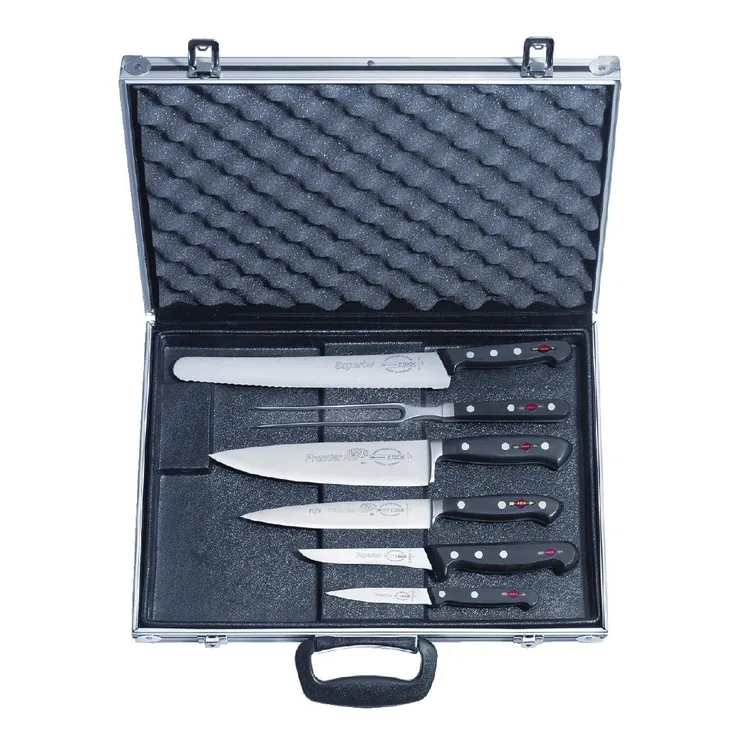
A more structured knife case or box is another option for storing and transporting professional kitchen knives.
This type of storage can be useful for chefs who regularly move a larger selection of equipment between workplaces, kitchens and catering venues.
Whichever format you choose, make sure it is appropriate for the knives you actually carry and that the blades can be stored securely inside it.
A vehicle should not be assumed to fall outside the rules.
CPS guidance explains that an article can still be considered to be “with” someone when it is nearby, under their control or immediately accessible, including in a vehicle.
It would therefore be unsafe to assume that chef knives can be left in a car indefinitely simply because they are normally used for work.
Where knives are being transported for a genuine work purpose, keep that connection clear and remove them from the vehicle once they no longer need to be transported for work.
Travelling by train, bus or other public transport does not remove the normal rules on carrying knives.
A chef travelling to or from work may still have the same potential work-related reason for carrying the knives required for their job.
The knives should genuinely be needed for the work and the connection between the journey and that work should remain clear.
A suitable knife wallet, roll or case is also a practical way of keeping blades securely contained inside your luggage.
Transport operators or particular locations may have additional conditions or security procedures, so check these separately where relevant.
There is no simple rule in the government guidance covering every stop, diversion or journey.
The relevant question is whether there remains a good reason for having the knife in the circumstances.
For chefs, keeping possession closely connected with the genuine work journey provides the clearest context. If your situation falls outside a straightforward work-related journey and you are unsure whether your reason would be considered sufficient, seek appropriate legal advice.
The consequences can be serious.
In England and Wales, illegally carrying a knife or bladed article in public can result in up to four years in prison, an unlimited fine, or both.
Penalties differ elsewhere in the UK. In Scotland, the relevant legislation provides for a maximum of five years' imprisonment on conviction on indictment.
When taking your professional knife kit outside the kitchen, it is sensible to check:
The reason for carrying the knives is the key legal consideration. Secure storage is sensible handling practice rather than a separate legal requirement.
For chefs building or replacing a professional knife kit, our professional kitchen knives range includes chef's knives alongside specialist knives for boning, carving, filleting, paring and other kitchen preparation.
For storage and transport, browse:
Chefs can have a legitimate reason for carrying professional kitchen knives when they are genuinely required for work.
That does not provide a general right to carry knives at other times. The reason for possessing the knife, its connection with the work and the surrounding circumstances all matter.
Keep your knife kit connected to the job for which it is needed, transport it sensibly and avoid carrying professional knives unnecessarily.
For the latest legal position, always check current government guidance and legislation or seek legal advice if you are unsure about your circumstances.